
The Best Era in DCS Just Got Better: WW2 in the Pacific, the Corsair, and Why Wartime

There is a moment in every DCS pilot's journey where the jets, as spectacular as they are, stop being enough. You have mastered the HOTAS, you have memorized the startup checklist, you have flown enough F-16 sorties to fill a deployment rotation.Then someone puts you in the cockpit of a P-51 Mustang over a cloud broken Channel and something changes. The noise is different. The feel is different. The consequence of every decision is different. That is what WW2 aviation in DCS does to you.
Right now, in 2026, it has never been a better time to fly warbirds in DCS World. The Marianas WW2 map has brought the Pacific theater to life in a way the community has been wanting for years. The F4U Corsair has given Pacific and Atlantic flyers one of the most iconic propeller aircraft ever built. The La-7 has arrived to represent Soviet aviation at its wartime peak. And all of this sits on top of a WW2 module ecosystem that already includes some of the most detailed and lovingly modeled aircraft in the entire DCS library.
The Marianas WW2 Map: The Pacific Theater Finally Gets Its Due
For a long time, the WW2 experience in DCS was largely a European affair. Normandy. The Channel. The Caucasus adapted for Eastern Front scenarios. Incredible content in all of it, but the Pacific, the theater that defined naval aviation and produced some of the most legendary air battles of the entire war, was missing.
The Marianas WW2 map fixes that.
The Mariana Islands sit roughly in the middle of the Pacific Ocean, and in 1944 they were the epicenter of the Pacific air war. The Battle of the Philippine Sea, nicknamed The Great Marianas Turkey Shoot by American aviators, took place in June 1944 and resulted in one of the most lopsided aerial victories in history. Japanese naval aviation, already badly depleted, was effectively broken. The islands of Saipan, Tinian, Guam, and Rota were captured in brutal fighting that summer and would later serve as the staging ground for the B-29 bombing campaigns against the Japanese home islands.
In DCS, the Marianas map captures this theater beautifully. The Pacific blue of the open ocean, the volcanic islands, the carrier operations, and the long over water legs that make navigation and fuel management genuinely matter. This is not a map where you take off and are immediately in a furball. Pacific theater flying demands patience, discipline, and energy management. It demands exactly the kind of flying that propeller aircraft reward.
For multiplayer, the Marianas WW2 map opens up mission types that are genuinely unique. Carrier intercepts, island defense scenarios, long range escort missions for strike packages, and naval ground attack. If you have a squadron that wants to run organized wartime campaigns, this map gives you a theater that feels utterly distinct from anything in Europe. The missions write themselves.
The F4U Corsair: An Icon That Earns Every Bit of Its Legend
Few aircraft in aviation history carry the cultural weight of the F4U Corsair. That inverted gull wing. That massive R-2800 radial engine producing 2,000 horsepower. The sound, and if you have ever heard a restored Corsair at an airshow you do not forget it. And in DCS, the Corsair delivers.
The F4U was one of the fastest single engine propeller aircraft of the war, with a top speed that could outrun most Japanese fighters in level flight. It was initially rejected for carrier operations due to poor forward visibility on landing approach, which is why the Marines got it first and proceeded to build an absolute legend with it in the Pacific. By the time carrier qualification issues were addressed, with some help from the British Royal Navy who operated it without the same objections, the Corsair was already a proven killer. Pilots like Pappy Boyington and Kenneth Walsh built their reputations in its cockpit.
In DCS, flying the Corsair on the Marianas map is one of those rare combinations where everything lines up. The theater, the aircraft, the era, it all fits. You can fly Combat Air Patrol over the fleet, fly ground attack against island targets, practice carrier landings on a moving deck with that famously awkward forward visibility, or just get into a turning fight with a Zero and experience firsthand why energy management mattered so much against Japanese fighters.
The Corsair is also a genuinely accessible WW2 module. The systems are period appropriate with no radar pages, no datalink, and no sensor fusion, which means your mental bandwidth goes to flying and fighting rather than systems management. For newer DCS players who want to try warbirds, the Corsair is a fantastic entry point.
The La-7: Soviet Excellence at Altitude
The Eastern Front produced some of the most intense, grinding, and large scale air combat of the entire war. The Luftwaffe and the Soviet Air Force fought over thousands of miles of front for years in a campaign of attrition that dwarfs anything that happened in Western Europe in terms of sheer scale. And by the latter stages of the war, Soviet aviation had gone from surviving to outright competing and then winning.
The La-7 represents Soviet fighter design at its absolute peak for the piston era. Designed by Semyon Lavochkin's bureau and entering service in 1944, the La-7 was fast, agile, and capable enough to take the fight to late war Luftwaffe opponents on even terms. Soviet ace Ivan Kozhedub, the highest scoring Allied ace of the war with 64 confirmed kills, flew the La-7 for many of his victories, including a remarkable engagement against a Me 262 jet late in the war.
In DCS, the La-7 gives pilots a Soviet perspective on WW2 air combat that is genuinely different from flying Western Allied aircraft. The handling characteristics are distinct. The instruments are in Russian. The cockpit layout reflects Soviet design philosophy. Flying it on the Caucasus map in an Eastern Front scenario creates an experience that feels historically grounded in a way that is hard to replicate in other titles.
For squadrons that run organized WW2 campaigns, the La-7 is essential. It fills out the Allied roster with a high capability Soviet fighter that genuinely changes the tactical equation. And for the historically curious, flying it is a direct connection to the brutal arithmetic of the Eastern Front.
Why WW2 Missions in DCS Are the Most Fun You Can Have
Here is the honest truth about WW2 missions in DCS: they are, for many pilots, the most viscerally enjoyable flying the sim has to offer. And the reasons are worth unpacking.
Gunnery is everything. Modern jet combat in DCS involves missiles, radar, and beyond visual range engagements where you often kill or die without ever seeing the opponent. WW2 combat is different. The guns require you to be close. They require proper lead, correct angle off, and a solid understanding of deflection shooting. A kill in a WW2 scenario means you earned it at gun range, which makes it feel entirely different.
The aircraft bite back. Modern aircraft in DCS are designed to be flown by human beings with very little margin for catastrophic loss of control. Warbirds are not. Torque on takeoff will put a P-51 into the scenery if you are not ready for it. Engine management including mixture, prop pitch, manifold pressure, and oil and coolant temperatures is a continuous and active responsibility. The Corsair landing behavior is notorious for a reason. These aircraft demand respect, and they reward you when you give it.
Missions have weight. There are no precision guided munitions in WW2 DCS. Bombing requires either shallow angle dive attacks or precision level approaches. Ground attack means coming down low and slow enough to aim, which puts you in the range of every anti-aircraft gun on the map. Escort missions mean staying with the bombers no matter what, even when bounced from altitude by enemy fighters. The tactical constraints of the era make every mission feel genuinely consequential.
The community around WW2 DCS is exceptional. Squadrons tend to be organized, knowledgeable, and deeply invested in getting the historical detail right. Flying in a properly organized WW2 campaign with period correct radio procedures, historically inspired mission structures, and pilots who know their aircraft is one of the best experiences online multiplayer flight simulation can offer.
The Full WW2 Map Lineup: More Theater Than You Can Fly
The Marianas is the newest addition, but DCS has been building out its WW2 map collection for years. Here is where you can take your warbirds.
Normandy 2.0 is the flagship WW2 map and the one most pilots will encounter first. It covers the D-Day invasion area including the Normandy beaches, Caen, the bocage, and the Channel coast with a fidelity that reflects years of development and community feedback. The airfield network mirrors the historical layout. You can fly from authentic period airstrips in England across the Channel to French targets, just as the Typhoon and Mustang pilots of 1944 did. It is the definitive Western Front experience in DCS.
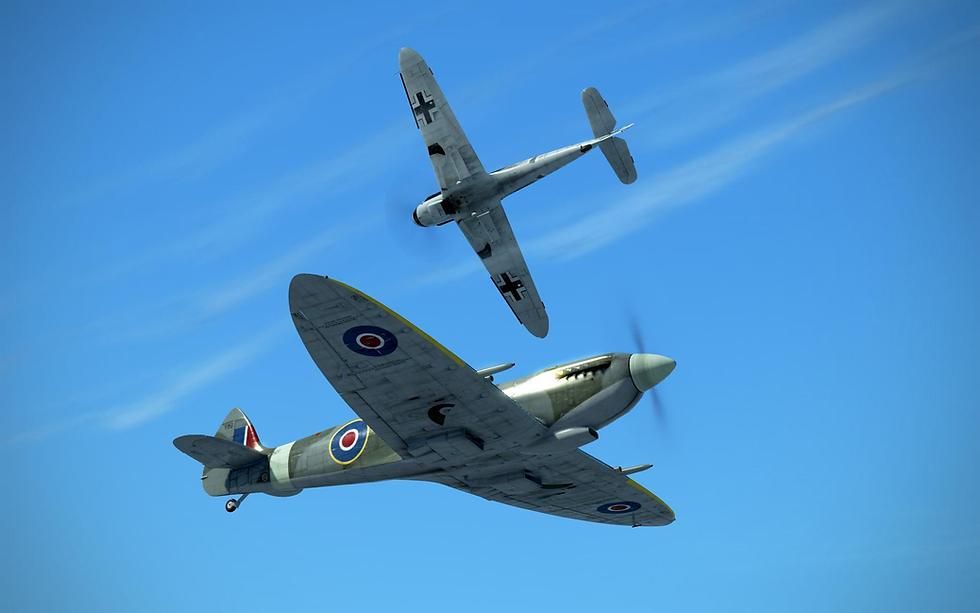
The Channel Map takes you back further to the Battle of Britain in 1940, the earliest and arguably most dramatic aerial campaign of the European war. Southern England, the Pas de Calais, and the white cliffs of Dover. The distances are short, the fighting is intense, and the stakes feel appropriately existential. Spitfires and Hurricanes against Bf 109s and Fw 190s over the Channel is some of the most historically charged flying available in any simulator.
The Caucasus, which is the original and default DCS map, was not designed specifically for WW2, but the Eastern Front scenario community has made excellent use of it for years. The geography suits Soviet German air combat reasonably well, and the wide open spaces support the kind of large scale operations that characterized the air war in the East.
Each map has a different character, a different tactical demand, and a different historical personality. The Marianas adds a Pacific dimension that none of the others can provide. The complete collection covers the war from the English Channel to the Central Pacific, which is a remarkable thing to be able to say about a flight simulator.
Fox3 Servers: Where WW2 Campaigns Come Alive
WW2 DCS is at its best in multiplayer. A solo WW2 session has its appeal, but the real payoff, including the escort mission where you actually have bombers to protect, the carrier intercept where your wingman covers your six, and the multi squadron campaign where pilots are counting on each other, only happens with other humans in the fight.
That is where Fox3 comes in.
Running organized WW2 multiplayer requires a server that performs. Warbird missions tend to be larger than typical jet missions in terms of ground unit counts, AI traffic, and players per session. Period authentic campaigns often run large numbers of AI aircraft to simulate the density of wartime airspace. All of that demands a stable, low latency, dedicated server and not a friend's gaming rig that goes offline when they go to bed.
Fox3 Managed Solutions runs dedicated DCS servers built for exactly this kind of use. Persistent missions, custom WW2 campaigns, high player counts, and the reliability that organized squadrons need. Whether your group is running a serious Battle of Britain campaign on The Channel map, a Pacific carrier operations rotation on the Marianas, or a Normandy campaign that has been running for months, the experience is fundamentally better on hardware that is always on, always ready, and always performing.
The Corsair, the La-7, and the Marianas map deserve a server that matches their quality. Your squadron does too.
The WW2 Golden Age in DCS Is Right Now
If there was ever a time to get into WW2 aviation in DCS, it is now. The module roster is as deep as it has ever been. The Marianas map has opened up a whole new theater. The Corsair and the La-7 have filled in gaps in the aircraft lineup that pilots have been asking for. The community running WW2 content is organized, welcoming, and genuinely committed to the craft.
The first time you break through a cloud layer at 15,000 feet over the Pacific in a Corsair, with a Japanese carrier group (available with mods) visible far below on the water and your wingman sliding into formation on your wing, you will understand why this corner of DCS has its own gravity. It is not just a flight simulator. It is the closest most of us will ever come to understanding what those pilots actually experienced.
Blue skies and tailwinds. See you over the Marianas.
At Fox3 Managed Solutions, we run dedicated DCS and IL-2 servers so you can focus on the flying, whether that is a solo WW2 campaign or a full squadron operation across the Pacific. Reliable, low latency, and always on. Check us out at fox3ms.com. Happy Flying.


Comments